
"beads not"
500 article(s) found

How's the deep-roasted East Timor coffee? Pure wild East Timor coffee beans where there?
Professional barista exchanges, please pay attention to coffee workshop (Weixin Official Accounts cafe_style) This summer's tail, autumn's beginning also want Amway you such a coffee East Timor is located in the sea north of Australia, full of many small coffee farmers

The difference between Costa Rican black honey and red honey and yellow honey hand-washed Costa Rican Tara beads black honey
Professional coffee knowledge exchange more coffee bean information please follow the coffee workshop (Wechat official account cafe_style) Costa Rica black honey what taste black honey coffee how to brew yellow honey, red honey, black honey treatment, where is the difference? When you want to buy honey-treated coffee, you usually have the choice of yellow honey, red honey and black honey. You may have heard of these honey treatments to keep the fruit separately.

Detailed explanation of coffee utensils using siphon pot
The coffee made by the siphon pot is more mellow because a large amount of coffee oil is dissolved in the coffee liquid, so the coffee made by the siphon pot is more mellow and more fragrant. What most friends have is the so-called three-person siphon pot, not to mention whether it is made by three people, but you need it when you make it.
A clear and distinct cooking method: siphon style
Siphon tube is the most commonly used method in traditional coffee shops. when cooking, it is not only full of taste and smell, but also has the effect of visual display, but the quality of coffee varies greatly from person to person, which is the most criticized place. The complexity of the cooking process (pay attention! It is complexity, not difficulty) that leads to the decline of siphon type in various other ways.

Gentle and supple Costa Rican Tara Beads Coffee Bean Origin Development History Culture Introduction
Excellent Costa Rican coffee is called extra-hard and can grow at altitudes above 1500 meters. Altitude has always been a problem for coffee growers. Coffee beans are better at higher altitudes, not only because higher altitudes increase the acidity of coffee beans and thus enhance flavor, but also because lower night temperatures at higher altitudes can slow tree growth and thus

Light and pure sweet Costa Rican Tara beads boutique coffee beans origin development history and culture brief introduction
Coffee was introduced to Costa Rica from Cuba in 1729, and today its coffee industry is one of the most well-organized in the world, producing up to 1700 kilograms per hectare. Costa Rica has a population of 3.5 million, but coffee trees number 400 million, and coffee exports account for 25% of the country's total exports. The volcanic soils of Costa Rica are very fertile and well drained, especially in the central part.

Flavor Clear Costa Rican Tara Beads Fine Coffee Bean Origin Development History Culture Introduction
The Colombian people say coffee has changed the country and has made a remarkable contribution to its rich environment.Although Colombia ranks third from the bottom in terms of land area in Central America, its economic environment is better than half that of other countries.Because of its rich people and stable society, Costa Rica has more than 30 national parks. Coffee in 1729

Siphon tube is the most commonly used method in traditional coffee shops.
Siphon tube is the most commonly used method in traditional coffee shops. when cooking, it is not only full of taste and smell, but also has the effect of visual display, but the quality of coffee varies greatly from person to person, which is the most criticized place. The complexity of the cooking process (pay attention! It is complexity, not difficulty) that leads to the decline of siphon type in various other ways.

Light and pure sweet Costa Rican Tara beads boutique coffee beans grinding degree baking degree treatment method simple
Costa Rica's coffee industry, originally controlled by the Costa Rican Coffee Industry Company (InstitutodelCafdeCostaRica, ICAFE), has been taken over by the official Coffee Committee (OficinadelCaf). Among the exported coffee, those products that are considered to be of substandard quality are colored with blue vegetable dyes and then transferred back to China for sale. Coffee consumed at home

A brief introduction to the description of the flavor and aroma characteristics of Costa Rican Tara beads boutique coffee beans
Costa Rican coffee has full particles, ideal acidity and unique strong flavor. Costa Rican coffee has full particles, ideal acidity and unique strong flavor. The coffee industry in Costa Rica, originally controlled by the Costa Rican Coffee Industry Company (InstitutodelCafdeCostaRica, ICAFE), has been taken over by the official Coffee Committee (OficinadelCaf).

Single coffee Name Type Siphon pot Practice Introduction
1. Preparation: a set of siphon pot, coffee cup, coffee spoon, sugar bag and milk ball; 2. Assembly siphon pot; 3. Add water visually: pour nine full parts of water into siphon pot with single coffee cup,(wipe dry lower seat to avoid being burned); 4. Heating: insert upper seat obliquely to observe the condition of chain beads; 5. When chain beads hang water, the water temperature of lower seat is about 80 ℃; 6. Water film has been formed on rubber ring of lower seat.

The scenery of Hainan Coffee Garden is charming.
White jade carved green leaves, coral beads United, braving the rain to see the coffee, lingering can not bear to return. The flowers often bring rain, and the smell is as strong as milk. The mountain birds call at night and pick up fallen pearls in the Ming Dynasty. This is a "Bodhisattva Man" depicting the coffee garden. Anyone who has been to the coffee garden will applaud the author's poem. The scenery of the coffee garden on Hainan Island is charming, and the coffee produced in Hainan Island is also fragrant.
Common sense of Coffee cultivation in China Hainan Coffee
White jade carved green leaves, coral beads United, braving the rain to see the coffee, lingering can not bear to return. The flowers often bring rain, and the smell is as strong as milk. The mountain birds call at night and pick up fallen pearls in the Ming Dynasty. This is a "Bodhisattva Man" depicting the coffee garden. Anyone who has been to the coffee garden will applaud the author's poem. The scenery of the coffee garden on Hainan Island is charming, and the coffee produced in Hainan Island is also fragrant.

A brief introduction to the varieties of grinding scale of Tarazhu coffee beans in Costa Rica by the method of describing taste and flavor
Costa Rica Tarazu coffee beans taste description processing method grinding scale varieties Tarazhu as the origin of coffee beans have long been known, coffee harvest season, high-quality beans will receive an additional bonus, and only beans selected after a strict cup, only to Fancy specifications out of the stock. The last time I drank this Tara bead, high altitude SHG grade, is

Siphon coffee maker (Syphon)
Siphon coffee pot, also known as Syphon. It was developed by Robert, an engineer of the Scottish Navy. Robert Napier invented it in 1840. Although the siphon coffee pot is called the siphon pot, it has nothing to do with the siphon principle. Instead, it uses water heating to produce water vapor, which causes the principle of hot expansion and cold contraction. It pushes the hot water from the lower seat to the upper pot, and produces negative after the next pot cools.
About the siphon coffee maker
Siphon coffee pot, also known as Syphon. It was developed by Robert, an engineer of the Scottish Navy. Robert Napier invented it in 1840. Although the siphon coffee pot is called "siphon pot", it has nothing to do with the siphon principle, but uses water heating to produce water vapor, resulting in the principle of hot expansion and cold contraction, pushing the hot water from the lower seat to the upper pot and waiting for the next pot to cool.

Coffee vessels introduce siphon coffee maker
Siphon coffee pot, also known as Syphon. It was developed by Robert, an engineer of the Scottish Navy. Robert Napier invented it in 1840. Although the siphon coffee pot is called the siphon pot, it has nothing to do with the siphon principle. Instead, it uses water heating to produce water vapor, which causes the principle of hot expansion and cold contraction. It pushes the hot water from the lower seat to the upper pot, and produces negative after the next pot cools.
Boutique Coffee legends about Coffee
Coffee flowers carved white jade leaves, coral beads knot. Looking at the coffee in the rain, I couldn't bear to go back. The flowers often bring rain, and the smell is as strong as milk. The mountain birds call at night and pick up fallen pearls in the Ming Dynasty. Walk into the coffee garden in May or June and see the oval pea-sized coffee fruit you won't let me. I will press you, you are next to me, and I squeeze you, gathering in the petioles one by one and bending the branches.
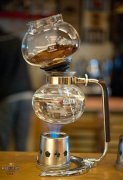
Hand coffee brewing skills siphon coffee pot brewing coffee
Siphon coffee pot, also known as Syphon. It was developed by Robert, an engineer of the Scottish Navy. Robert Napier invented it in 1840. Although the siphon coffee pot is called the siphon pot, it has nothing to do with the siphon principle. Instead, it uses water heating to produce water vapor, which causes the principle of hot expansion and cold contraction. It pushes the hot water from the lower seat to the upper pot, and produces negative after the next pot cools.

Siphon coffee maker (Syphon) is also known as plug pot.
Siphon coffee pot, also known as Syphon. It was developed by Robert, an engineer of the Scottish Navy. Robert Napier invented it in 1840. Although the siphon coffee pot is called the siphon pot, it has nothing to do with the siphon principle. Instead, it uses water heating to produce water vapor, which causes the principle of hot expansion and cold contraction. It pushes the hot water from the lower seat to the upper pot, and produces negative after the next pot cools.